The Geniza Research Project for Hebrew Poetry was established by the Israel Academy in 1967, with the aim of deciphering, identifying and cataloguing fragments of liturgical poems (piyutim) preserved in the Cairo Geniza.
The Geniza Research Project for Hebrew Poetry was established by the Israel Academy of Sciences and Humanities in 1967, with the aim of deciphering, identifying and cataloguing fragments of liturgical poems (piyutim) preserved in the Cairo Geniza. The initiative was made possible by the Institute of Microfilmed Hebrew Manuscripts of the National Library of Israel (NLI), which consolidates photographs of the manuscripts in most of the Geniza collections around the world. In addition, today there are excellent scans of Geniza fragments available on various websites. The scanned fragments often make it easier to decipher the material and enable us to identify many previously unidentified piyutim.
The cataloguing of the poems in most of the major Geniza collections has been completed. The project’s database now contains nearly 100,000 titles of piyutim from the Geniza and the opening words of over 70,000 piyutim that exist in print. Most of the major collections of Geniza fragments have already been deciphered. One large collection of Geniza fragments still to be catalogued is the Firkovich Collection in St. Petersburg. In addition, a number of minor collections have yet to be catalogued, and some of the collections that were already catalogued require supplementation.
The project is named after its founder, the late Prof. Ezra Fleischer, who directed it for 39 years. Prof. Fleischer passed away in July 2006. His life’s work is carried on by Academy Member Prof. Shulamit Elizur, assisted by a steering committee that includes two Academy members. Most of the deciphering, cataloguing and computerization has been done by the project’s permanent staffer, Dr. Sarah Cohen.
The project’s work has changed in the past two years: Following an agreement signed between the Israel Academy and the NLI gradually to transfer the project to the NLI, the latter, as a condition for implementation, asked to receive all of the material in the project’s databases, with the aim of adding it to the NLI’s Merhav site. In keeping with the late Prof. Fleischer’s directive not to transfer unreviewed material, and to prevent possible errors, the past two years have been devoted almost entirely to an intensive review of the material. So far, volumes 131–160, 193, 194, 198–209, 231 and 232 in the New Series in the Taylor-Schechter Collection at Cambridge University, each containing hundreds of fragments, have been thoroughly examined. Volumes 233–240 have also been reviewed, but they have not yet been entered into the database. This process has included a reexamination of the photographs of the fragments on the basis of the excellent scans on the site of the Friedberg Jewish Manuscript Society, which are much superior to the photographs that were available to Prof. Fleischer.
The scans, together with the large amount of data amassed in the database, have enabled the complex identification of fragmentary material and the identification of many previously undeciphered piyutim, as well as corrections and adjustments to the texts of identified poems. Much data on the poems has been added, and thousands of corrections have been made in the database. In addition, data was added on fragments of piyutim from the Rylands Collection at the University of Manchester, Collection A, fragments 1–1370, which were deciphered and then checked by Prof. Elizur in preparation for entering the information into the database.
Several comprehensive volumes of piyutim in the project’s database have been published in the last two years, including Prof. Elizur’s Sod Meshalshei Qodesh: The Qedushta from Its Origins until the Time of Rabbi El'azar Berabbi Qillir and Dr. Eden Hacohen’s The Yoserot of Rabbi Selomo Suleiman Al-Sinjari for the Annual Cycle of Torah Reading. Upon the publication of a new edition, the published versions of the piyutim are added to the database.
Another new development is enriching the project’s database: As noted, the Firkovich Collection in St. Petersburg has yet to be systematically catalogued. Dr. Matti Huss of The Hebrew University of Jerusalem was recently awarded a four-year research grant by the Israel Science Foundation to catalogue the collection. Most of the work is being done by Kedem Goldin, in conjunction with Dr. Cohen. Since the cataloging project began in November 2019, full details have been entered on more than 1,430 poems in this important collection.
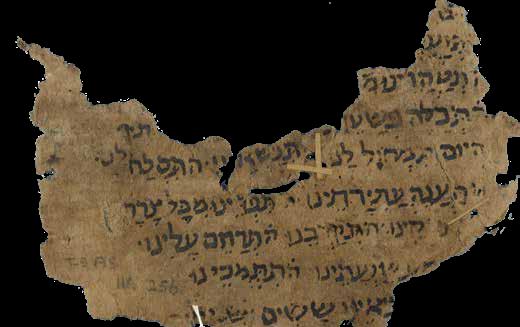
A fragment of Hayom Te’amtzaynu (“Strengthen us today”), a well-known piyut recited on the High Holidays, from the Additional Series in the Taylor-Schechter Collection at Cambridge University (T-S AS 116.256). All of the volumes of piyutim in this collection have been catalogued in recent years, and their contents have been entered into the database of the Geniza Research Project for Hebrew Poetry. (Reproduced by kind permission of the Syndics of Cambridge University Library).
In early January 2019, all of the material in the database was transferred to the NLI with the assistance of Dr. Avi Shmidman. The NLI recently added the material to its website, and it is now accessible to anyone interested. However, the project’s software offers more detailed and complex data, and scholars from around the world continue to contact the staff with questions. They receive assistance, focused responses and detailed reports, enabling them to advance in their research. The material in the catalogues has served for years as the basis for most of the volumes of Geniza poetry and piyutim published in Israel and elsewhere. The new identifications that have emerged from reviewing the material have already helped several scholars improve the editions that they are preparing.
The Onomasticon of Eretz Israel Project
The Onomasticon of Eretz Israel (The Onomasticon of Iudaea • Palaestina and Arabia in the Greek and Latin Sources) consolidates all the passages in Greek and Latin that mention geographic and ethnic names in Eretz Israel (Palestine) and its immediate vicinity, from the middle of the fourth century BCE (shortly before the conquest of the area by Alexander the Great) until the Muslim conquest in the middle of the seventh century CE. The project, founded in the 1960s by the late Professor Michael Avi-Yonah, was directed by the late Professor Yoram Tsafrir (a Member of the Israel Academy from 2001) from the 1970s until his passing in November 2015.
The excerpts collected in the Onomasticon, culled from all the known Greek and Latin sources, are drawn from over 1,300 texts, written or edited by over 750 authors and editors, including major compositions, correspondence, sermons, administrative and ecclesiastical lists, inscriptions and coins; and from sources in Near Eastern languages, mainly Syriac, which were translated from the Greek. In the published volumes, the entries for the place names are arranged alphabetically. The excerpts within each entry are arranged chronologically, in the source language and in English translation, accompanied by essential textual notes, geographical-historical discussions and, where possible, archeological discussions as well, along with a research bibliography. Wherever possible, sites are identified and described based on the most current research.
Volume I, by Leah Di Segni and Yoram Tsafrir with Judith Green, was published in 2015. This volume presents major texts that mention many names and are therefore excerpted in a number of alphabetical entries. It also contains an annotated directory of Primary Sources, a general list of abbreviations and an index of all the locations included in the series, as well as an introduction and indexes. The collection of all the major texts in the first volume allows easy access to these longer passages, as the entries themselves contain only concise excerpts relating to the specific places.
Volume II, by Leah Di Segni and Yoram Tsafrir, published in 2017 in two parts, contains all the entries beginning with the letter A, including the prodigious entry on Arabia.
Volume III, containing the entries for the letter B, is in the final stages of preparation for press. It will also include Addenda to the Primary Sources, primarily critical editions that were not available when the first and second volumes were prepared, as well as new text publications (inscriptions, papyri) and sources of which the authors were unaware in earlier stages of the work.
Starting with the letter C, the material will be published in electronic format. For this purpose, a digital application was developed by Hagit Bagno to serve as a platform for entering the texts in Greek and Latin, with all of the related information, and making this data available to the entire research community. Thus far, all of the Latin and Greek texts for the letters D and E and about half of those for the letter C have been entered, the majority with their English translations. Further Addenda to the Primary Sources have been prepared for these three letters, and these, along with the Addenda for the letter B, will be combined with the original list of Primary Sources.
Volume III is to be followed by the publication of an electronic volume devoted to sacred places: shrines, synagogues, churches, monasteries, charitable foundations administered by the church and tombs of saints (if they are identified explicitly by name). The groundwork for this volume has been prepared, including the citations, in chronological order, texts, bibliography and proposed identifications.
The Middle Persian Dictionary Project
The dictionary project is a collaborative effort of the Israel Academy of Sciences and Humanities, the Accademia dei Lincei in Rome, the Académie des Inscriptions et Belles-Lettres in Paris and the Union Académique Internationale. The project’s director and associate director are, respectively, late Prof. Shaul Shaked of the Hebrew University, a member of the Academy, and Prof. Carlo Cereti of Sapienza University of Rome. Since Prof. Cereti has been serving as Italy’s cultural attaché in Tehran in recent years, he is not currently active in the dictionary project. The project coordinator is Dr. Domenico Agostini, who has resided in Israel for about six years.
During the first stage of the project, all of the relevant texts in Middle Persian were uploaded to a dedicated Internet site, including, as far as possible, the entire corpus of Zoroastrian literature in Middle Persian; a selection of texts in Pazend (a late script used by Zoroastrian writers); the Manichaean texts in Middle Persian discovered at Turfan, written in one of the scripts of the Syriac language (courtesy of Prof. Desmond Durkin-Meisterernst, composer of the Dictionary of Manichean Middle Persian and Parthian); and the epigraphic inscriptions in Middle Persian on slabs and seals, as well as other archeological findings, such as papyri and parchment documents.
The plan is to also document words in Middle Persian that appear as borrowed words in texts in neighboring languages, such as the various dialects of Aramaic, Armenian and Arabic.